


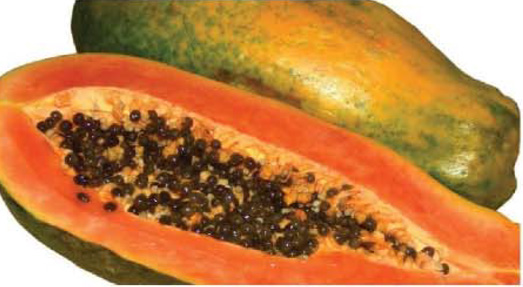
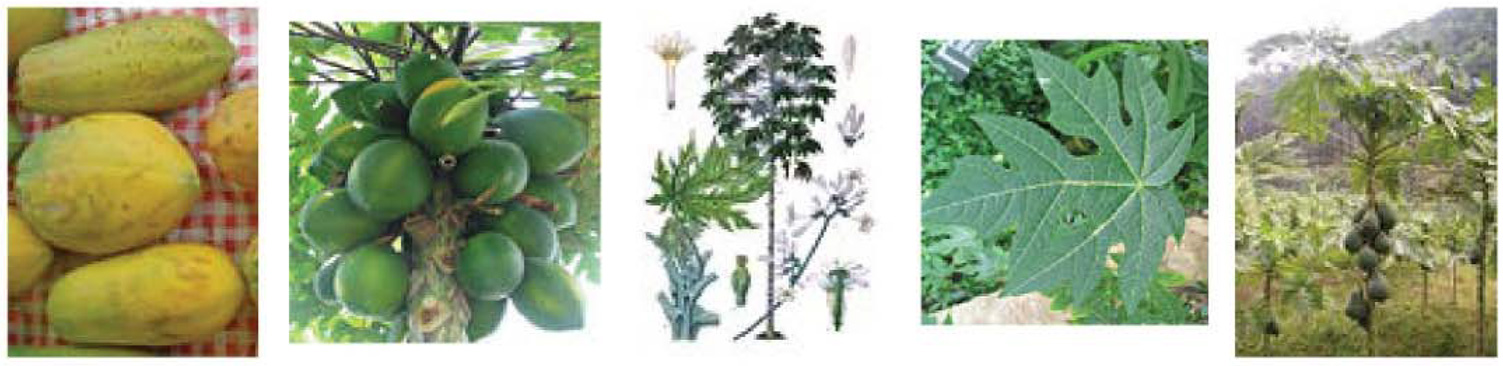
Papaya is a palm-like, soft-stemmed, evergreen tree, Carica papaya, that is native to the tropics of the Americas, but which is now cultivated in tropical and warm, semi-tropical zones around the world. Papaya also is the name for the large, juicy, melon-like, edible fruit of this tree, which has black seeds in the center and typically ranges in color from an amber to a yellow hue.
GEOGRAPHY OF PAPAYA
Papaya, (Carica papaya), also called papaw or pawpaw, succulent fruit of a large plant of the family Caricaceae. Though its origin is rather obscure, the papaya may represent the fusion of two or more species of Carica native to Mexico and Central America.
VERNACULAR NAMES
• Latin Name: Carica papaya Linn English Name: Papaya, Pawpaw, Melon tree
• Hindi Name: Andakharbuja, Arand- kharbuza, Papal, Papita
• Arabic Name: Arand kharbuza
• Persian Name: Aanabahe-hindi, Am- ba-hindi
TEMPERAMENT
Warm and dry (1st order).
• Urdu Name: Papita Family: Caricaceae
• Sub Kingdom: Tracheobionta • Kingdom: Plantae • Order: Brassicales • Genus: Carica
INTRODUCTION
Papaya (papita) is grown abundantly in India, Pakistan and Bangladesh. It is digestive and helps to remove flatulent from the stomach, which in turn pro- vides relief in abdominal pain, vomiting and diarrhoea. Carica papaya is a tropi- cal fruit having commercial importance because of its high nutritive and me- dicinal value. Papaya has two seasons for cultivation. One starts from July-Au- gust, while the other from February-March. It is a fast growing plant that can bear fruit in 5-6 months. India leads the world in papaya production with an annual output of about 3 million tonnes. Other leading producers Brazil, Mexico, Nigeria, Indonesia, China, Peru, Thailand and Philippines. It is now present in every tropical and subtropical country. Papaya is seen in orange-red, yellow-green and yellow-orange, with a rich orange pulp.
PHYSICAL DESCRIPTION
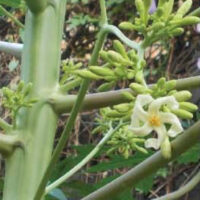
The papaya plant is considered a tree, though its palm like trunk, up to 8 metres (26 feet) tall, is not as woody as the designation generally implies. The plant is crowned by deeply lobed leaves, sometimes 60 cm (2 feet) across, borne on hollow petioles (leaf stalks) 60 cm long. Normally, the species is dioecious, male and female flowers being produced on separate plants, but her- maphroditic forms are known, and numerous irregulari- ties in the distribution of the sexes are common.
CULTIVATION
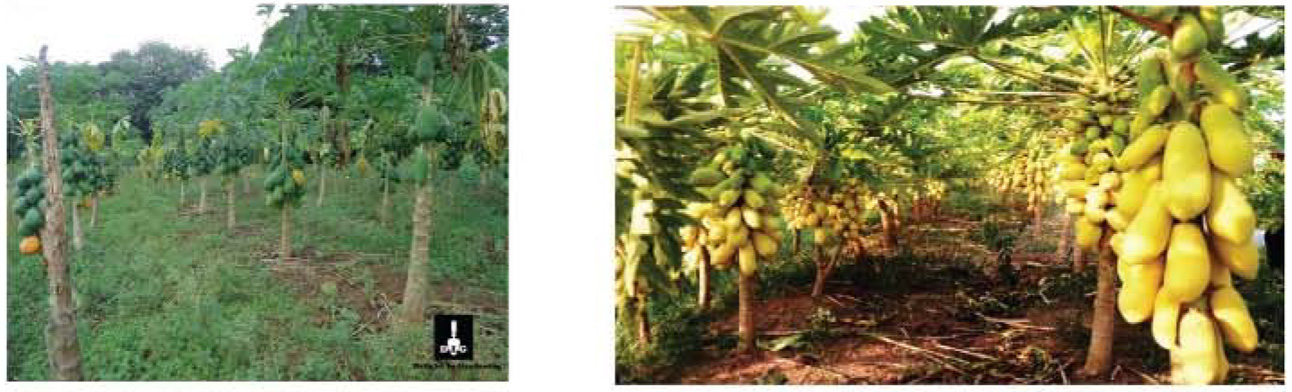
Papayas are usually grown from seed. Their development is rapid, with fruit being produced before the end of the first year. Under favourable conditions, a plant may live five years or more. Papaya is native to the tropics of the Ameri- cas, and was cultivated in Mexico several centuries before the emergence of the Mesoamerican classic cultures. It also is native to Central America and northern South America. Today, the papaya is cultivated in most countries with a tropical or warm semi-tropical climate like Brazil, India, South Africa, Sri Lanka, and the Philippines.
ECONOMIC IMPORTANCE
Fruit is a rich source of vitamin A and C. It has a high nutritive and medicinal value. Papain prepared from dried latex of its immature fruits is used in meat tenderizing, manufacture of chewing gum, cosmetics, for degumming natu- ral silk and to give shrink resistance to wool. It is also used in pharmaceutical industries, textile and garment cleaning paper and adhesive manufacture, sewage disposal etc.
HOW DOES PAPAYA WORK?
Papaya contains a chemical called papain. Papain breaks down proteins, carbohydrates, and fats. That’s why it works as a meat tenderizer. Papaya also con- tains a chemical called carpain. Carpain seems to be able to kill certain parasites, and it might affect the central nervous system.
NUTRITIONAL VALUE OF PAPAYA
2.7 g dietary fiber, or 10 percent DV.
31 milligrams (mg) calcium, or 3.1 percent DV.
33 mg magnesium, 8 percent DV.
286 mg potassium, 6.08 percent DV.
0.13 mg zinc, 0.9 percent DV.
95.6 mg vitamin C, 106.2 percent DV.
58 micrograms (mcg) folate, 14.5 percent DV.
1,492 international units (IU) vitamin A, 30 percent DV.
0.47 mg vitamin E, 2.4 percent DV.
4.1 mcg vitamin K, 5.1, percent DV.





Informative article about papaya.